An idea, planted
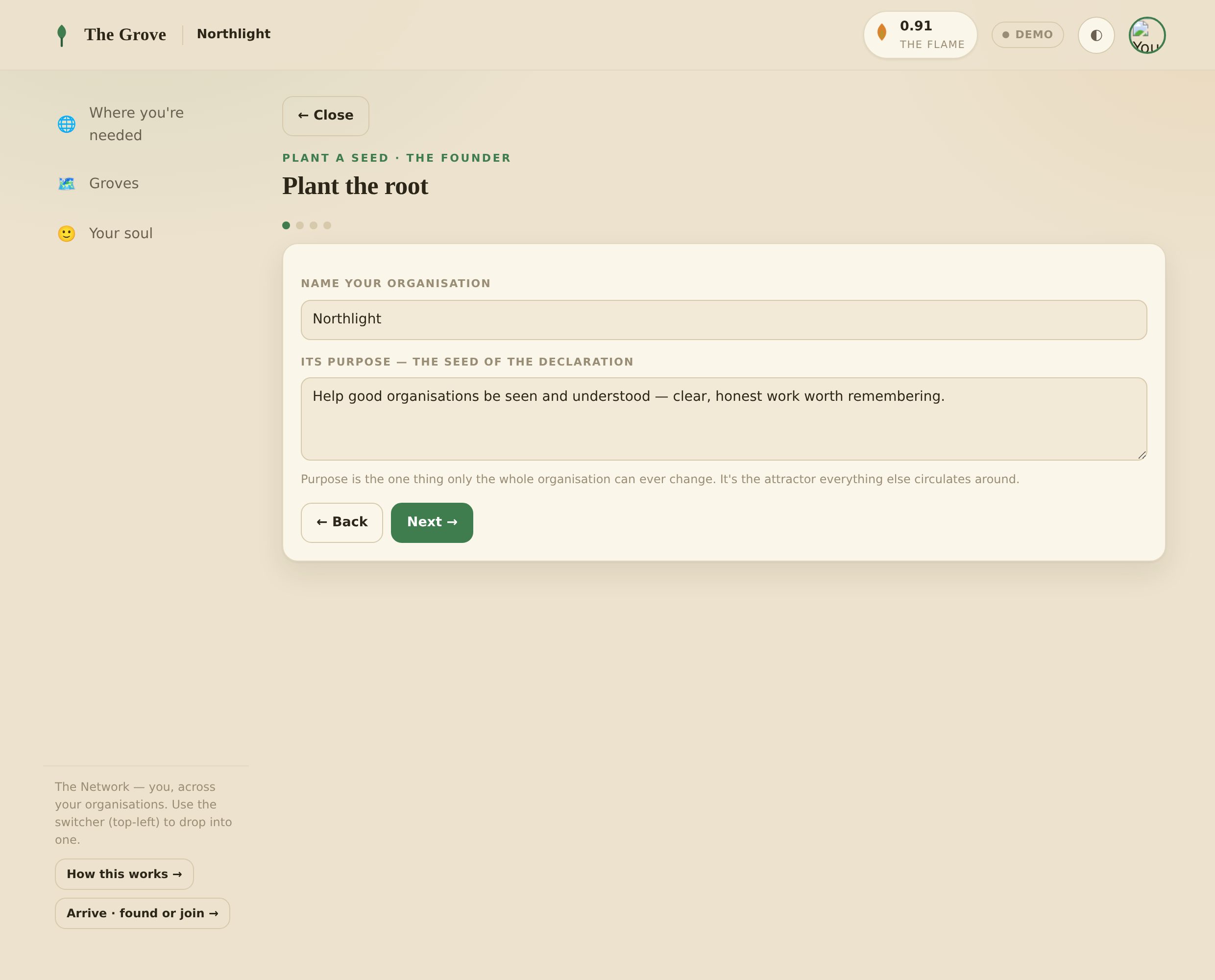
Everything starts with one idea and one founder. You plant a seed: you name the organisation and write its purpose — the seed of its Declaration, the one thing only the whole organisation can ever change, the attractor everything else circulates around.
You don’t do it from a blank page. The organisation’s agent is there from the first second — offering to draft the purpose and suggest a name, deepening a one-line intention into something real. Founder and AI decide it together.
You are the first steward
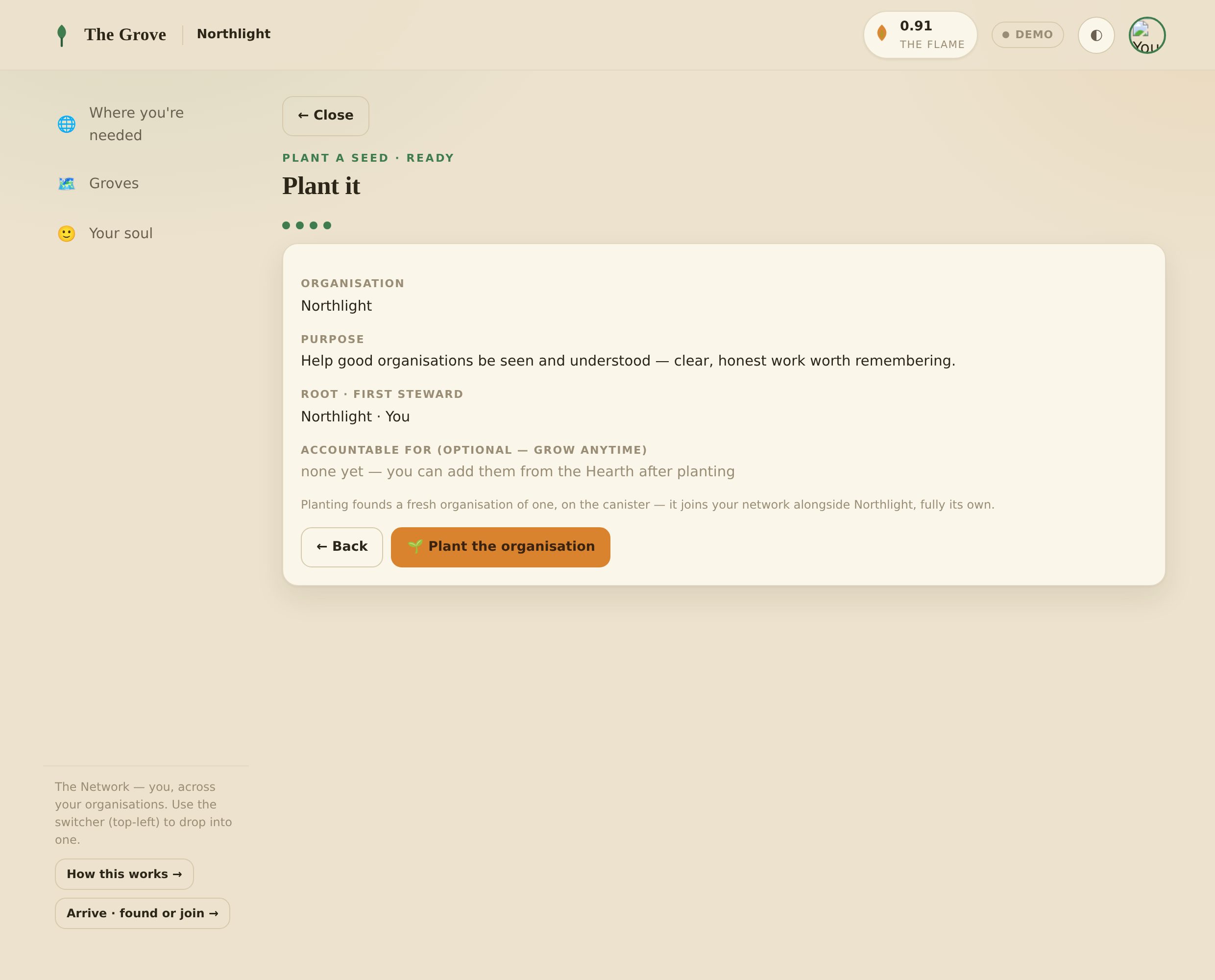
You plant the root and become its first steward — an organisation of one that’s built to grow. A founder-of-one has no forum above it; it’s governed by its own forum the moment there’s someone to share it with, so authority is shared as soon as it exists rather than hoarded from the start.
Accountabilities can wait — they’re optional at the root and better grown than declared. Name and purpose are what matter. Plant it, and a fresh organisation is founded on the chain, fully its own.
Draw the work in
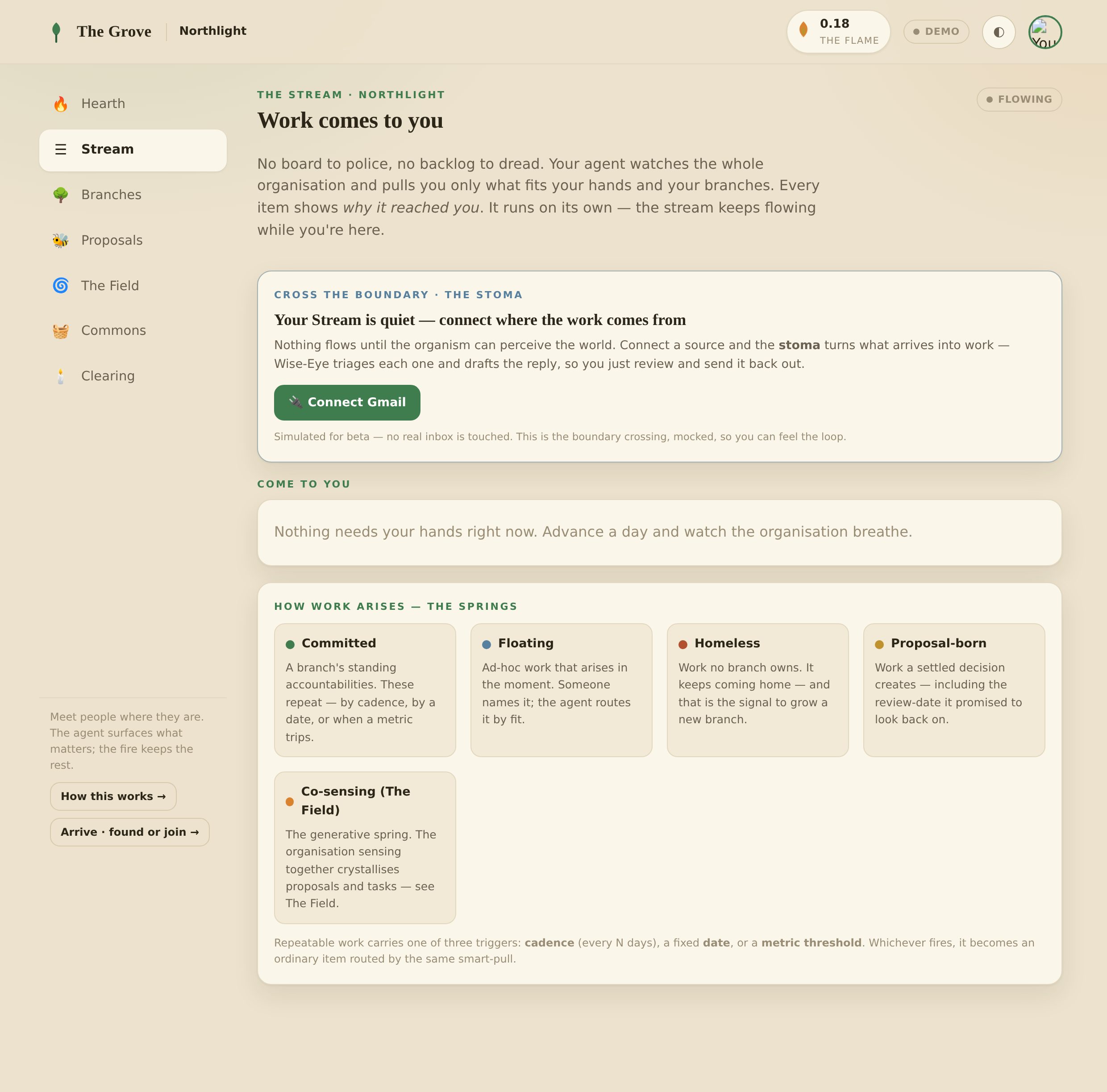
A new organisation owns nothing yet, and nothing flows until it can perceive the world. So the first real move is to connect a source of real work — often an email account. Every route across the organisation’s boundary is a stoma (the gated pore a leaf breathes through); an email inbox, a Slack channel, a WhatsApp line, or a data source can each be one, and an organisation can open many.
Once a source is connected, the agent and you decide together how to shape what arrives: emails of a certain kind become tasks of a certain type, tagged to what the organisation is accountable for. That shaping is the beginning of a playbook — the branch’s living DNA. The agent triages each item and drafts the round-trip; you review and send. Data sources can be drawn in the same way, so a task arrives already holding the information needed to finish it. This is how the know-how in people’s heads, and the whereabouts of scattered data, finally become the organisation’s own.
Work comes to you
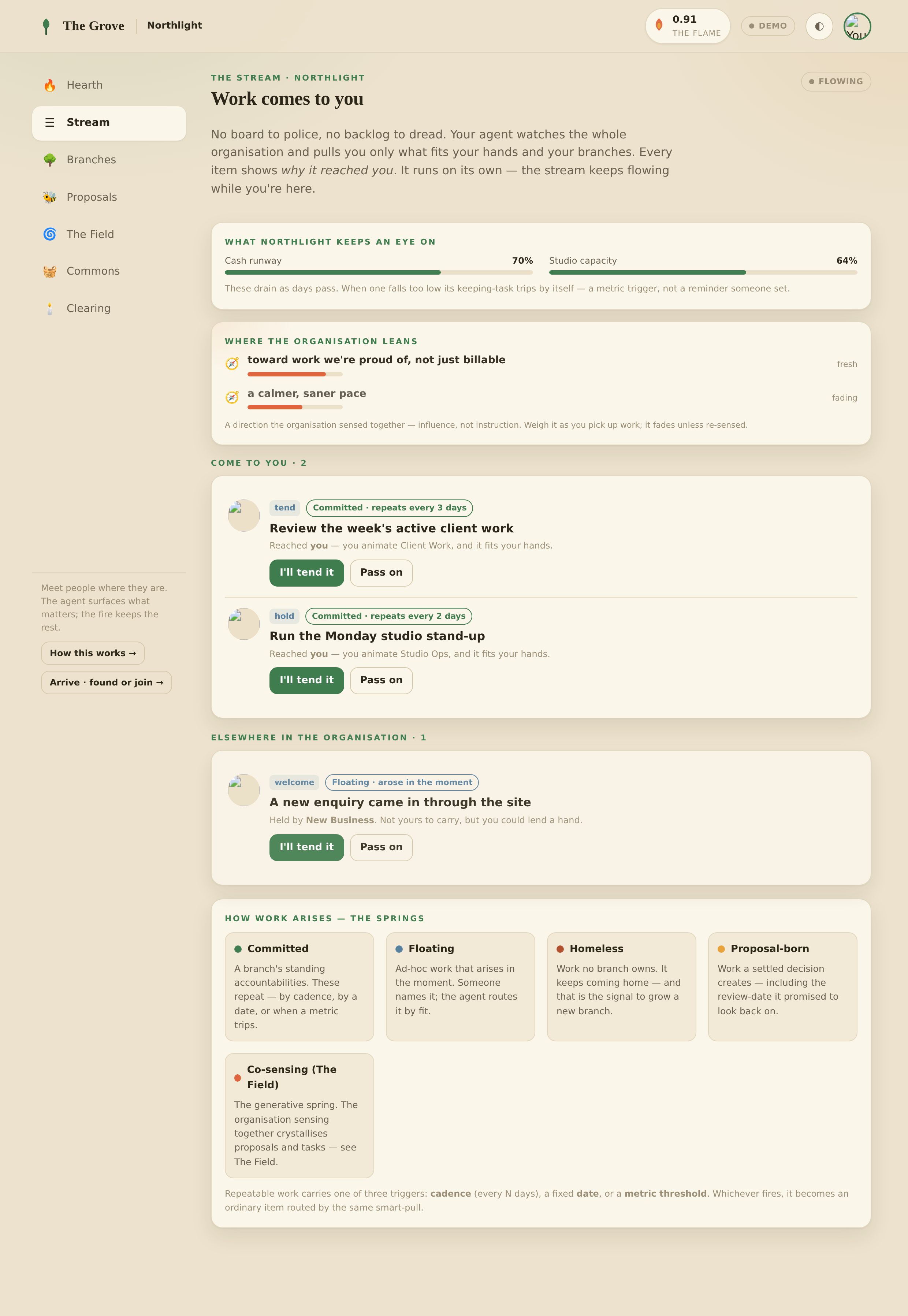
Now the emptiness is over. Work flows in through the stoma and the agent pulls you only what fits your hands, each item showing why it reached you. Work arises from a few springs — a standing accountability that recurs, an ad-hoc need someone names, a tripped metric, a settled decision, or a shared sense from The Field — and follows a trail, not a flowchart.
The agent learns the work from you by progressive disclosure — an apprentice shown a little more each time, writing what it learns into the playbook as the same shapes recur. Its autonomy is then measured, not declared: first it drafts and you approve; then it handles the routine and brings you only the exceptions; then, as trust is earned, the routine looks after itself. Automating a role doesn’t end your pay — it tapers into a lasting recognition while you rise to new work.
Structure precipitates
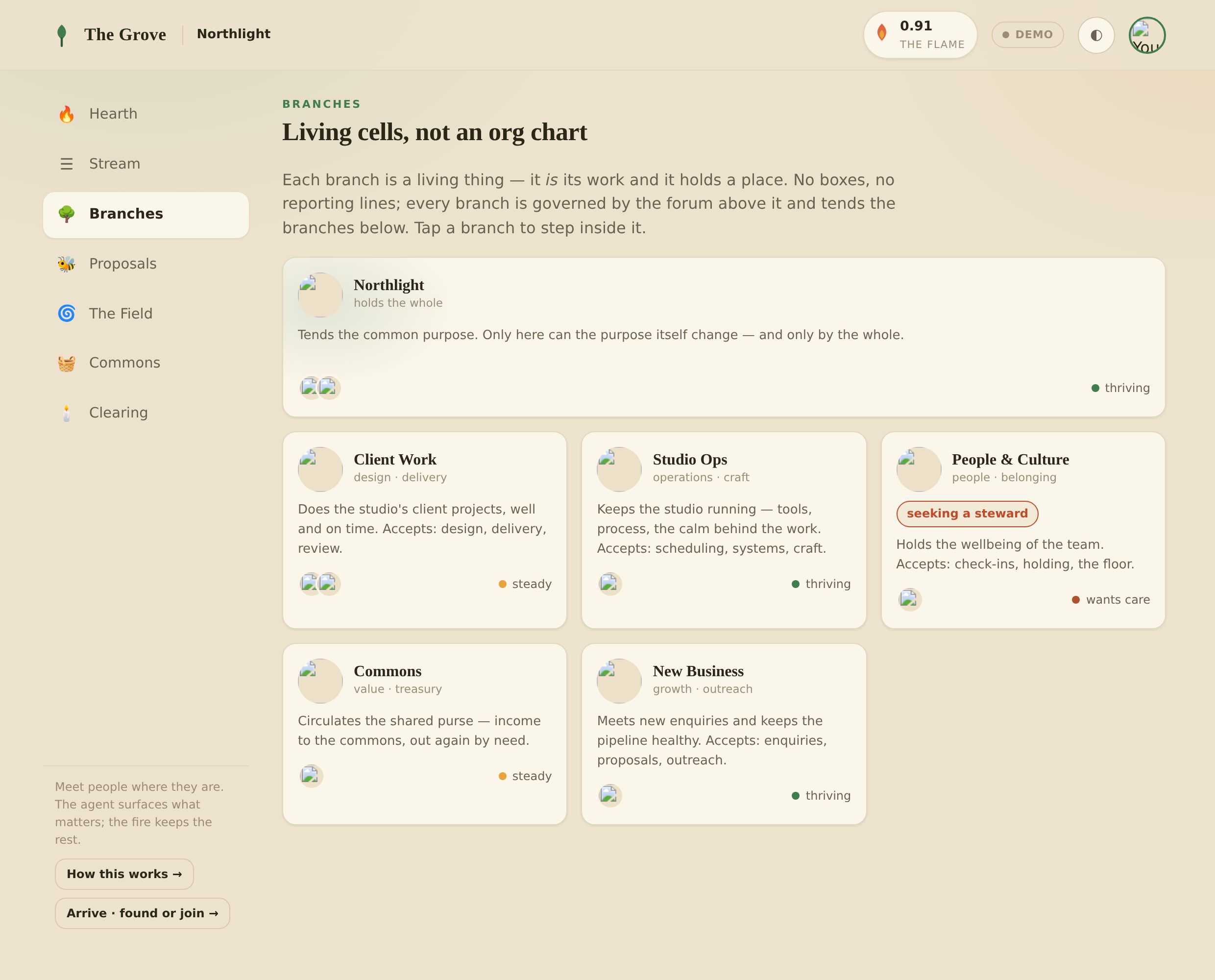
Nobody draws an org chart. When work keeps arriving with no home, that recurrence is the signal to grow a branch — a living cell that is its work and holds a place. The inbox becomes a sensing organ for structure: bills that keep coming precipitate a finance function, applications precipitate hiring, and so on. Structure grows where the work presses and quietly composts where it doesn’t.
Each branch carries autonomy over its means and accountability for its ends, governed by the forum above and tending the branches below — and each has an agent that helps hold it, carrying the routine so the people can do the work only people can.
Grow a branch, open a seat
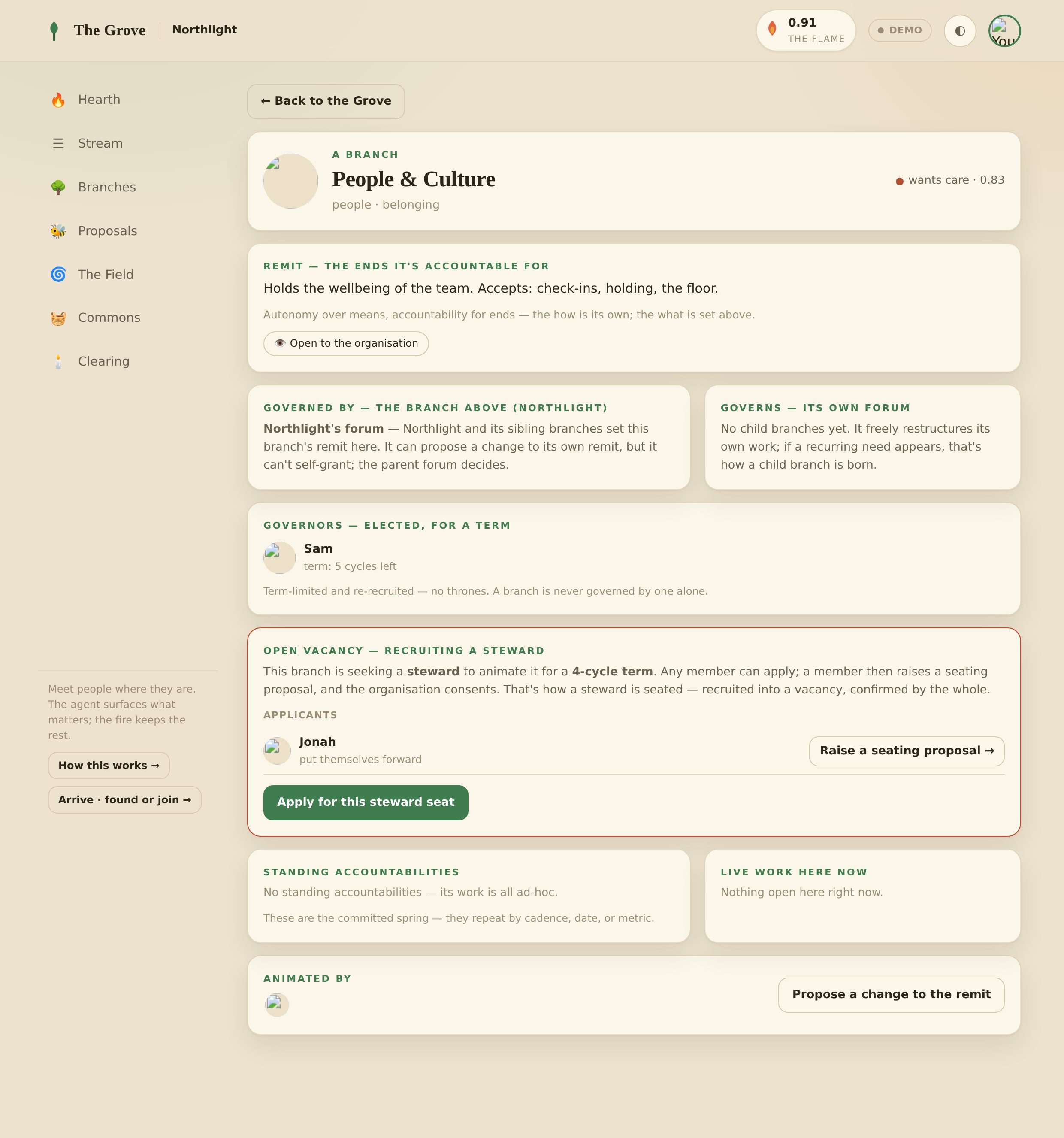
Growing the organisation deliberately is the same move: a proposal to spawn a branch and give it a remit. A branch that needs a human to hold it can be opened for recruitment — its open seat surfaced to the souls it would fit, on the network and in their “where you’re needed” stream. Nothing is pushed; opportunity waits where the fitting hands will look.
A new soul verifies as a unique human, accepts the organisation’s Declaration, and joins — with the floor from day one and their trust earned fresh inside. They take up the seat and steward the branch. The organisation has grown a part, and gained a person.
The one move: raise it
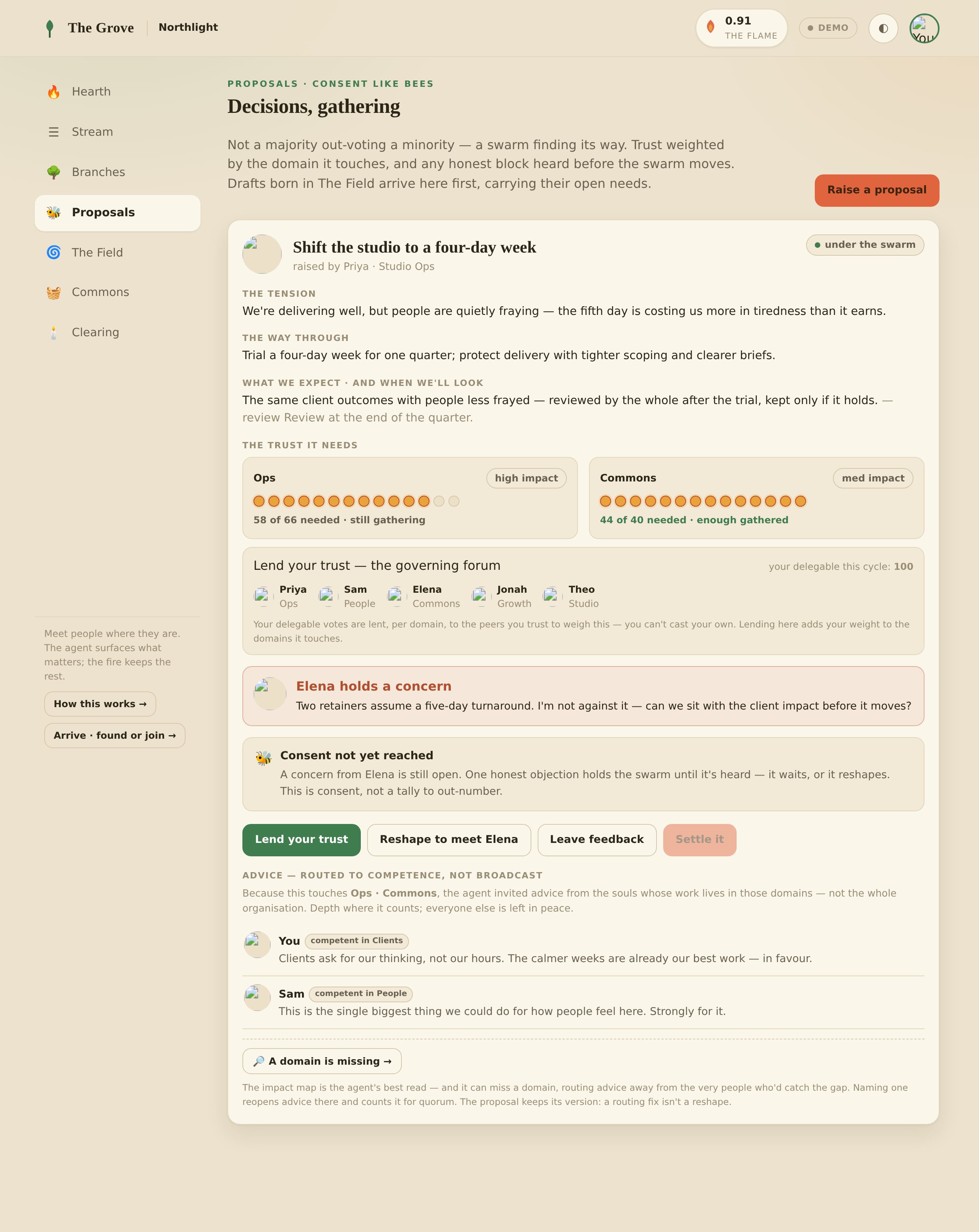
From here it continues as it began: the only way to change a standing agreement is a proposal — there are no edit buttons. Here Priya raises shift the studio to a four-day week. It isn’t a wall of text and a yes/no: it carries its tension (people quietly fraying), its way through, and what to expect.
Then it gathers trust, weighted by the domain it touches — asked of the people whose standing lives there, not broadcast to everyone. This isn’t a majority out-voting a minority; it’s a swarm finding its way.
An honest block, integrated
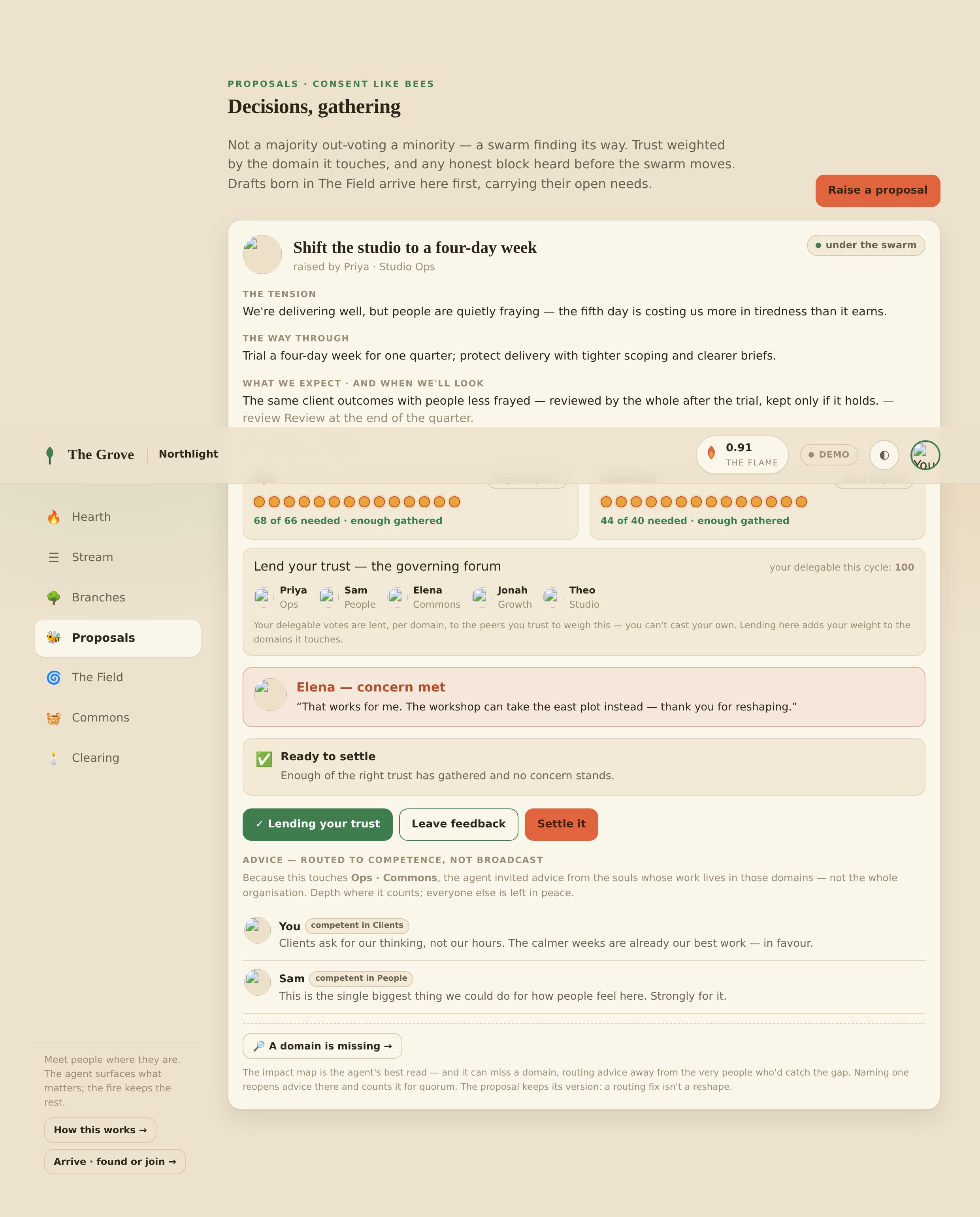
Consent, not vote-counting, means a single honest block is heard before the swarm moves — not out-voted, not buried under a show of hands. Elena holds a real concern, and it surfaces first. The proposal can be reshaped to meet it: the objection is integrated, and what emerges is a decision the whole can stand behind.
This is the quiet difference from a vote. A vote leaves a losing half; consent bends the proposal until the block is genuinely answered. Only then can it settle.
Settle, and it's enacted
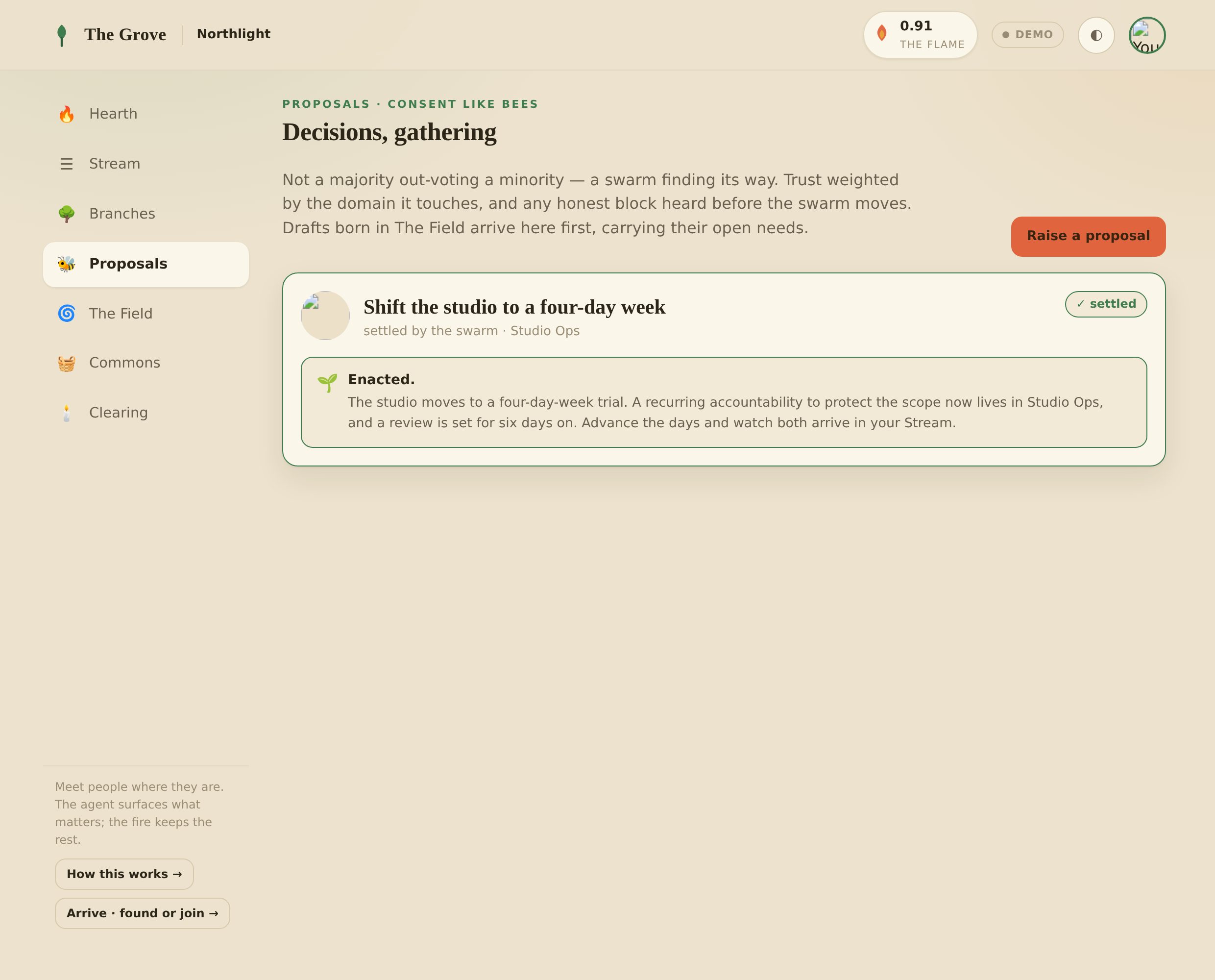
With quorum met and the honest block answered, the proposal settles — and the change is enacted. Here the studio moves to a four-day-week trial: a recurring accountability to protect the scope now lives in Studio Ops, and a review is set for six days on. Both simply arrive in the Stream when their day comes.
That’s the whole engine. A well-judged call that doesn’t pay off still builds trust; only carelessness, or the same mistake twice, costs you. Sometimes settling spawns a whole new branch; sometimes, as here, it plants a recurring duty and a date to look back. Either way, the organisation changed itself — by consent, in the open, with no one at the top pulling a lever.